
 Matching rotor/stator geometry, tip speed, and feed patterns reduces scale-up risk and provides reliable production targets for particle-size distribution, dispersion uniformity, and throughput. Use lab trials to optimize rotor tip speed, stator clearance, and propeller selection before committing to tooling or full-scale equipment purchases.
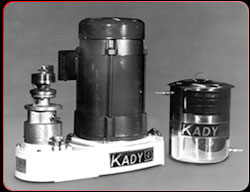 The Model LB is a fast, efficient unit for all types of mixing and dispersion needs. The results from this bottom entry unit correlate to the entire line of KADY® Mills. The LB is used in many plants for formulating for all plant production mills.
Bottom Entry Lab Mill Features
- The LB has a batch working capacity of one U.S. gallon.
- The unique KADY® dispersion head consists of a slotted stator inside a rotor and works on a theory of impingement.
- All wetted parts are standard in stainless steel.
- The Model LB requires only 1.41 square feet of space.
- The Model LB is equipped with a 3 horsepower motor.
- Custom engineering is available to meet your specific needs.
- Dispersions are made in minutes permitting sameday delivery of samples to customers.
- A one gallon stainless steel water jacketed vessel for heating or cooling is standard. Options include vacuum/pressure and high temperature jackets.
- Dry mixing blades and /or dissolver blades are optional.
- Vacuum operation is optional.
Process Correlation and Scaling Confidence
Both LT2000 and Model LB are built so results translate to larger KADY mills. Matching rotor/stator geometry, tip speed, and feed patterns reduces scale-up risk and provides reliable production targets for particle-size distribution, dispersion uniformity, and throughput. Use lab trials to optimize rotor tip speed, stator clearance, and propeller selection before committing to tooling or full-scale equipment purchases.
Options, Materials, and Cleanability
Available options include vacuum and pressure-rated configurations, interchangeable dispersion heads, jacketed or insulated vessels for thermal control, and sweep arms for improved mixing in small volumes. Wetted components are available in stainless steel and alternate alloys to address corrosion or sanitary requirements. Units are designed for straightforward disassembly, cleaning, and maintenance to support fast changeovers and minimize cross-contamination during development work.
 **Friendly Finance Options on Refurbished Mill Purchases**