
Bottom Entry Mills
 Since 1949, KADY International has been a leading manufacturer in the mixing industry; we specialize in premium products and outstanding customer service. We work with our customers in an effort to understand their unique application and process so that we can provide the best solution. Over the years we have worked with many industries that have required mills for a wide array of applications. Because of our long diverse history, we understand that not every application will require a mill with the same specifications. This is why we have developed a broad product line for each of our solutions, from our lab, inline and top entry mills to our unique bottom entry mills.
We work with each and every one of our customers every step of the way to ensure their satisfaction and provide a wide selection of bottom entry mills to cover a wide range of applications.
KADY®'s Bottom Entry Model & Specifications | ||||
Model # | HP | Operating VOL. (Max) | Rotor Speed | Dia. |
3 | 1 | 16,000 | 2" | |
10C | 10 | 5 | 8,500 | 4" |
15 | 10 | 8,500 | 4" | |
25 | 20 | 6,500 | 5" | |
30 | 60 | 6,500 | 5" | |
50 | 125 | 5,200 | 6.5" | |
75 | 250 | 5,200 | 6.5" | |
5C | 125 | 350 | 5,200 | 6.5" |
150 | 600 | 2,800 | 12" | |
200 | 800 | 2,800 | 12-16" | |
1000 | 250 | 1000 | 2,200 | 16" |
1400 | 300 | 1400 | 2,000 | 16" |
1600 | 350 | 1600 | 2,000 | 16" |
400 | 2000 | 2,000 | 16" | |
* For normal usage | ||||
Kady Intl. Mills

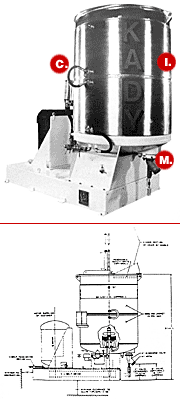
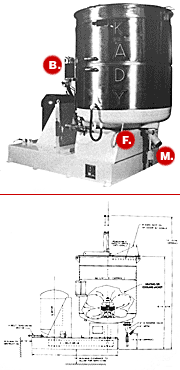
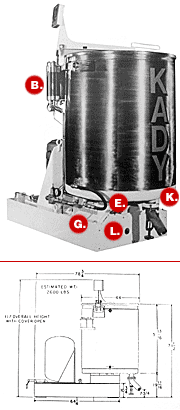


Applications & Design on Bottom Entry Mills
These mills are excellent for dispersions, emulsions, mixing, blending and homogenizing. By using energy transfer in the form of shear, impact and impingement—our mills are able to effectively disperse solid materials throughout a liquid in an even, uniform fashion. Our bottom entry mills can also be manufactured for applications requiring vacuum or pressure.
- One of the main components of our dispersion unit is the rotor. The function of the rotor is to provide the force that accelerates the solid particles into the liquid. This violent action is what deagglomerates and breaks up the particles. The particles are forced into the stator wall, broken apart and become mixed after impact. This action is much like throwing a snowball against a brick wall.
- The stator is what provides the barrier for high impact that is crucial to this process. The stator surrounds the rotor and is configured with slots that provide surface impact area and work to ensure all materials are aggressively mixed.
- In addition to the rotor, our dispersion units have two propellers: one on top of the rotor and one under the rotor. These props serve to create additional flow within the vessel and to force the materials into the rotor repeatedly to create a fine dispersion. These propellers can be modified according to the application or specifications of our customers’ application.
- Propellers come in a few different shapes from flat to marine style; each design caters to a unique flow pattern.
- Lastly, head plates fit snugly against the top and bottom of the stator and act to sandwich the slots thus concentrating the force of the material through the slot only and to help avoid "spill-over".
Design And Engineering Support
KADY engineers work directly with your team to translate process goals into top or bottom-entry mill configurations that deliver consistent results. We provide CAD reviews, material-compatibility guidance, and process modeling to recommend rotor, stator, propeller, and head-plate arrangements that optimize shear, impact, and impingement for your formulation. Early engineering includes suggested mill type, slot geometry, and rotor stator clearances to balance throughput and particle-size targets while avoiding spill-over and dead zones.
Customization And Vessel Integration
Bottom-entry mills are often fitted into existing tanks or supplied with matched vessels built to KADY tolerances. We supply custom shaft lengths, flange patterns, and tank-adaptation kits so mills fit your piping, footprint, and structural requirements. Options include vacuum or pressurizable designs, seismic-rated supports, and explosion-mitigation features. These customizations reduce retrofit complexity, limit civil work, and speed commissioning.
Dispersion Technology and Process Optimization
The rotor-stator interface defines dispersion performance. KADY optimizes rotor slot tangency, rotor/stator clearance, and propeller feed patterns to force solids repeatedly into high-shear zones for aggressive mixing and deagglomeration. Upper and lower propellers are selected to create positive feed to the rotor across a range of viscosities and solids loadings. We tailor energy input and staging for pigment dispersions, emulsions, homogenization, or high solids slurries to deliver the particle size and throughput your process requires.
Installation, Commissioning, And Performance Validation
We support installation, mechanical alignment, and electrical integration to verify the mill and tank operate together as intended. Commissioning includes rotor/stator clearance checks, vibration and temperature monitoring, and first-batch trials to confirm dispersion targets. Baseline performance data and start-up protocols are provided so operators can reproduce results and troubleshoot quickly when process variables change.
Maintenance, Spare Parts, And Life-Cycle Upgrades
Planned maintenance and access to consumable parts extend uptime and lower life cycle cost. KADY supplies spare rotors, stators, head plates, propeller options, and wear-part reman services. Upgrade paths include hardened or coated rotors for abrasive media, alternative stator alloys for corrosion resistance, and horsepower or drive-train retrofits to increase throughput as your production needs grow.
 **Friendly Finance Options on Refurbished Mill Purchases**